
Top Sensitive Skin Care Trends to Watch in 2026 & 2027
Sensitive skin care is evolving from reactive treatment to long-term barrier-focused and microbiome-driven strategies, shaping how modern products are formulated and positioned.
How to Develop Sensitive Skin Skincare Products: Step-by-Step Guide
Developing sensitive skin products requires a careful balance between efficacy and skin tolerance, with a strong focus on barrier support, low-irritation ingredients, and formulation stability. Unlike conventional skincare, where performance is often driven by high-strength actives, sensitive skin formulations must deliver visible results while minimizing the risk of irritation and maintaining long-term skin comfort.
Best Ingredients for Sensitive Skin: How to Choose Soothing and Barrier-Repair Ingredients

The best ingredients for sensitive skin are those that help calm inflammation, strengthen the skin barrier, and maintain hydration without increasing irritation risk. Ingredients such as ceramides, panthenol, centella asiatica, and beta-glucan are widely used because they support skin recovery while improving overall skin resilience. These ingredients are not only popular in consumer skincare but are also widely adopted in modern product development strategies targeting sensitive or compromised skin.
Sensitive Skin Care: Causes, Ingredients, and How to Support Skin Barrier

Sensitive skin refers to skin that reacts easily to environmental factors, skincare ingredients, or physical stimuli. It often presents symptoms such as redness, burning, stinging, itching, or dryness when exposed to triggers that normally would not irritate resilient skin. In many cases, sensitive skin is associated with a weakened skin barrier, which allows irritants and allergens to penetrate the skin more easily.
Sensitive skin is usually caused by a weakened skin barrier, exposure to irritants, environmental stress, or underlying skin conditions. When the skin barrier becomes compromised, it cannot effectively retain moisture or block irritants, making the skin more reactive to skincare ingredients, pollution, temperature changes, and other external triggers.
Skincare ingredients for sensitive skin are typically selected for their ability to soothe irritation, strengthen the skin barrier, and support long-term skin resilience. Modern sensitive-skin formulations often focus on calming inflammation, improving hydration, and restoring the skin’s protective barrier to reduce reactivity.
Retinal vs Retinol: What’s the Difference and Which Is Better for Skin?
Retinal and retinol are both vitamin A derivatives used in skincare to support skin renewal, collagen activity, and overall skin texture improvement. While they belong to the same retinoid family, they differ in how efficiently they convert into retinoic acid—the biologically active form of vitamin A in the skin.
The Anatomy of a Skincare Product: What’s in My Skincare Products?
The anatomy of a skincare product refers to the structured composition of a formula, including its base, active ingredients, supportive systems, texture agents, and preservation strategy. Rather than individual ingredients working alone, skincare products function as integrated systems, where performance depends on how each component interacts within the formulation.
How to Achieve Glass Skin: The Ultimate Step-by-Step Guide
Glass skin has grown into one of the most recognizable expressions of contemporary beauty because it captures a shift that has been building for years: the move from makeup-first beauty to skin-first wellbeing. Instead of relying on layers of foundation or brightening filters, younger consumers are prioritizing the underlying condition of their skin — clarity, hydration, smoothness, and natural luminosity. This reflects a broader global trend where the health of the skin itself matters more than any cosmetic that sits on top of it.
Younger generations, in particular, have embraced minimalist makeup and clean, lightweight finishes. Full-coverage looks are giving way to barely-there complexion products that enhance a natural glow rather than mask imperfections. This cultural shift not only changed how beauty is expressed but also influenced which products are considered essential. Hydrating serums now replace heavy primers, dewy moisturizers replace thick creams, and SPF becomes the ultimate complexion enhancer. Glass Skin embodies that philosophy — beauty that starts at the source.
The rise of social media has amplified this transition. Platforms like TikTok, Instagram, and YouTube have made skincare routines more visible, converting them from private habits into public expressions of self-care and identity. “Skin-first aesthetics” became a visual language of wellness: close-up shots of dewy skin, minimalist routines, ingredient call-outs, and hydration-focused rituals. Glass Skin became the symbol of this movement because it is both aspirational and achievable — a look defined by consistency, not perfection.
Consumers today are also far more ingredient-conscious. They are moving away from harsh resurfacing treatments and intense exfoliation trends of past years and gravitating toward routines that emphasize hydration, clarity, and barrier integrity. This aligns closely with the core of Glass Skin, where long-term radiance relies on supporting the skin’s natural functions rather than over-correcting them. The emphasis on gentle formulations, microbiome balance, and barrier-safe actives makes the Glass Skin philosophy compatible with the broader 2026 skincare values: gentleness, prevention, and consistency.
In many ways, Glass Skin is not just a visual trend but a new standard of modern skincare — a reflection of evolving beauty values and a growing respect for biologically aligned routines. It represents healthy skin at its best, and that is why it continues to resonate so strongly with today’s skincare generation.
Experience What’s Next in Skincare with Blackbird at Cosmoprof Miami 2026
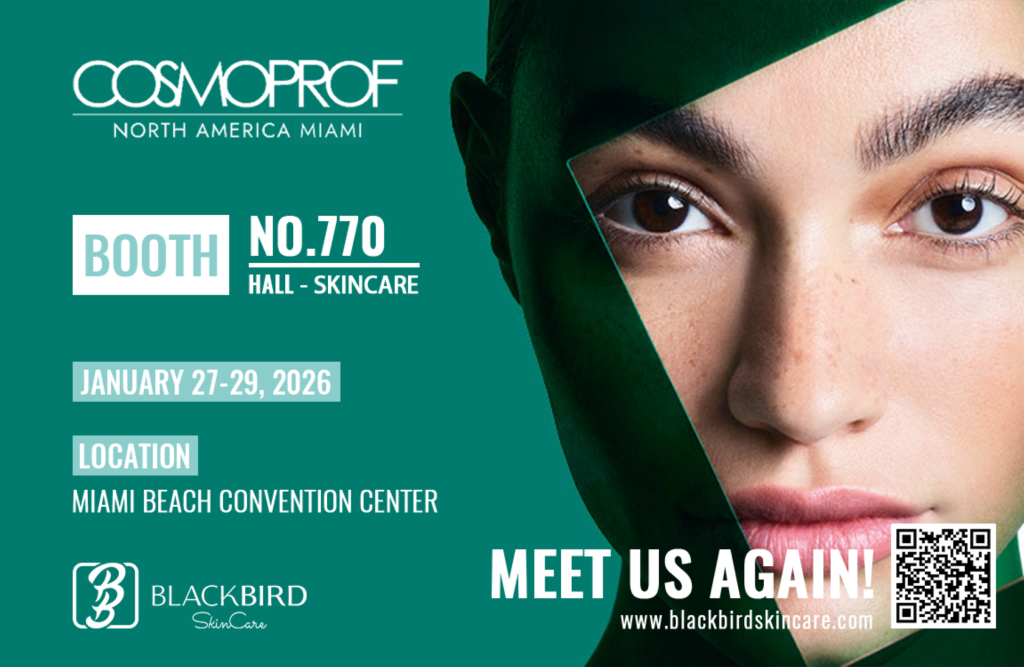
We are pleased to share that Blackbird Skincare will once again be exhibiting at Cosmoprof Miami 2026, continuing our commitment to presenting forward-thinking skincare innovation on an international stage. The event will take place January 27–29, 2026, gathering leading beauty professionals, founders, distributors, retailers, and product developers from across the Americas for three days of discovery, formulation insight, and global connection.
Cosmoprof Miami has quickly become one of the most influential B2B beauty exhibitions in this region — a destination where new material technologies, clinical-inspired formulations, finished beauty product showcases, and market-shaping trends come together. As a show that connects every part of the beauty supply chain, it is an essential platform for businesses seeking future-ready product direction, partnership opportunities, and competitive innovation. For Blackbird Skincare, returning to this stage reflects our continued growth in international brand collaboration and our mission to help partners develop sophisticated skincare products with science-led performance and commercial feasibility.
We invite attendees, brand builders, private-label explorers, and those looking to elevate their product catalog to visit us at the show. This year, we will showcase an expanded selection of new-generation skincare collections — offering visitors the opportunity to touch, test, and experience what the future of advanced formulation looks like. Whether you’re exploring concept development, trend forecasting, or ready-to-launch product options, Blackbird Skincare welcomes you to connect, sample, and envision what beauty can become next.
Top 13 Skincare Trends to Watch in 2026
2026 is shaping up as a transition year — a moment where skincare evolves beyond surface-level beauty and becomes a branch of long-term skin health management. The traditional approach of treating skincare like makeup with added moisture is fading. In its place comes a philosophy built on prevention, barrier resilience, and biological longevity. Instead of asking Whatmakes my skin glow today?, more consumers are asking What keeps my skin youthful 10 years from now?This shift in mindset is pushing the entire industry to move from appearance-focused beauty to true dermatological wellbeing.
The expectations placed on products are also changing. Quick-fix promises or “instant radiance” claims are no longer convincing on their own; buyers want formulations that are clinically supported, physiologically meaningful, and trackably effective. Demand is rising for ingredients that do more than brighten — they repair DNA damage, protect the microbiome, regulate inflammation, and sustain collagen architecture. Regenerative technologies such as exosomes, growth factors, multi-peptides, and longevity-based actives are entering mainstream product development because they align with this new long-horizon way of thinking.
At the same time, technology is expanding what skincare can achieve. AI-driven analysis, biotech-fermented actives, and dermatological research are merging with formulation science, enabling hyper-targeted and biologically intelligent product design. Skincare is no longer separated into categories like “beauty” and “science”; the future blends them into one. This convergence — biological prevention, evidence-backed innovation, and intelligent formulation — is why 2026 stands out as a defining turning point. Skincare is no longer just cosmetic; it is functional, preventative, and increasingly personal.
This guide explores the Top Skincare Trends to Watch in 2026, revealing where ingredients, product development, consumer expectations and technology are heading next — and how brands can align with the future rather than follow it. The trends that lead will be those rooted in science, built for long-term skin health, and capable of proving real, measurable results.
Top 10 Private Label Facial Toner Pads Manufacturers 2025 & 2026
Rank Name Country Product Range 1 Blackbird Skincare China 🇨🇳 Hydrating Toner Pads, Brightening Toner Pads, Soothing Toner Pads, Anti-Acne Toner Pads, Pore-Tightening Toner Pads, Peptide Repair Toner Pads, Niacinamide Clarifying Toner Pads, Vitamin C Radiance Toner Pads, Centella (Cica) Calming Toner Pads, AHA/BHA/PHA Exfoliation Toner Pads, Post-Treatment Recovery Toner Pads 2 Sourcing-lab Korea 🇰🇷 […]